From Manual Admin to Seamless Checkout

The Challenge
The organisation offered five distinct membership types: Individual, Student, Early Career, Retired, and Organisational. Each came with its own pricing structure, rules, and discount variations. Alongside these, there were 16 Special Interest Groups (SIGs), which members could join for an additional fee.
SIGs weren’t fully integrated into the membership structure. Instead, they relied on custom data fields. Staff had to manually enter end dates. Tracking renewals required attention and time.
There was also the challenge of organisational purchasing. If one person from a university or institution wanted to purchase multiple memberships for colleagues, there was no simple way to do it in one go. Each membership had to be processed separately. Each invoice generated individually. Each payment was handled one by one.
Events had similar constraints. Registration was capped at nine people per transaction, and every attendee’s details had to be entered manually. For large organisations, this was frustrating and time consuming.
The Solution
The introduction of the Shopping Cart feature changed everything. Originally designed to allow an organisational representative to purchase multiple memberships in a single transaction, it evolved into something much more powerful.
Built using FormBuilder and SearchKit, the new system allows users to add items to abasket just like an online store.
Now, a representative could:
- Select multiple individuals
- Assign each the appropriate membership type
- Add SIGs where required
- Include donations if desired
- Apply discount codes
- Generate a single invoice
- Complete one payment
What once required repeated manual processes could now be completed in a single transaction..
The Solution, next Steps:
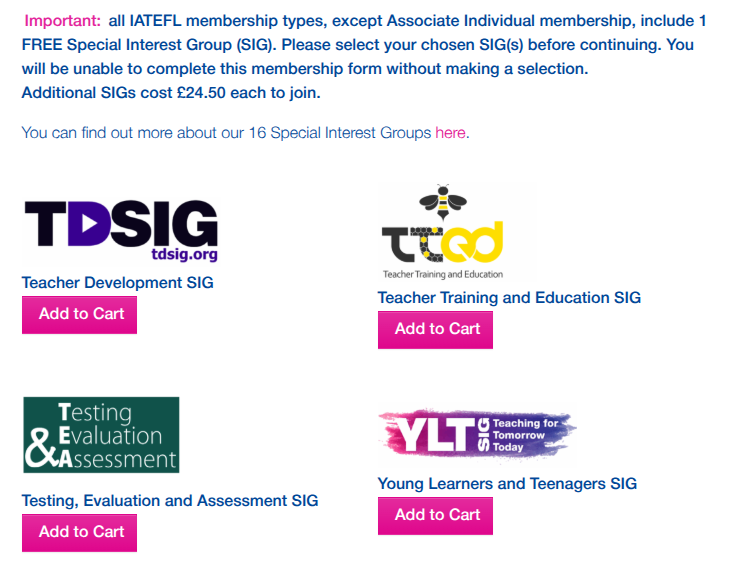
At the same time, SIGs themselves were rebuilt. Rather than existing as manually managed custom fields, SIGs were rebuilt as membership types in their own right.
This simple structural change had a profound effect. MJW created a new user portal forall users of IATEFL’s site, from registered only users, to organisation membership contacts. The portal expands its options as the contact increases their membership level.
For example an individual may become the main contact of an organisation;
- They would then be able to update organisation details,
- Add new employees, remove old employees
- Purchase memberships and SIG’s for their employees.
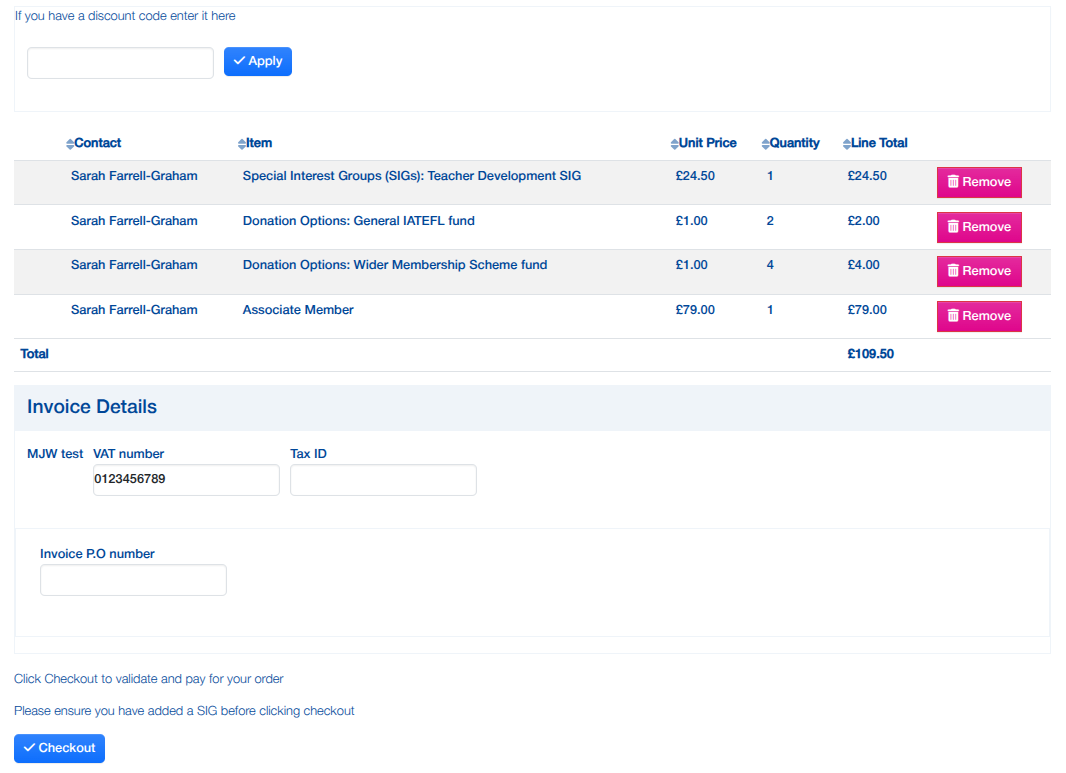
The shopping cart also introduced automation that had never existed before. When four or more memberships are added to the cart, the system automatically applies a 20% discount. No manual checking. No calculations. No risk of inconsistency.
For the first time, bulk purchasing logic became embedded in the system itself.
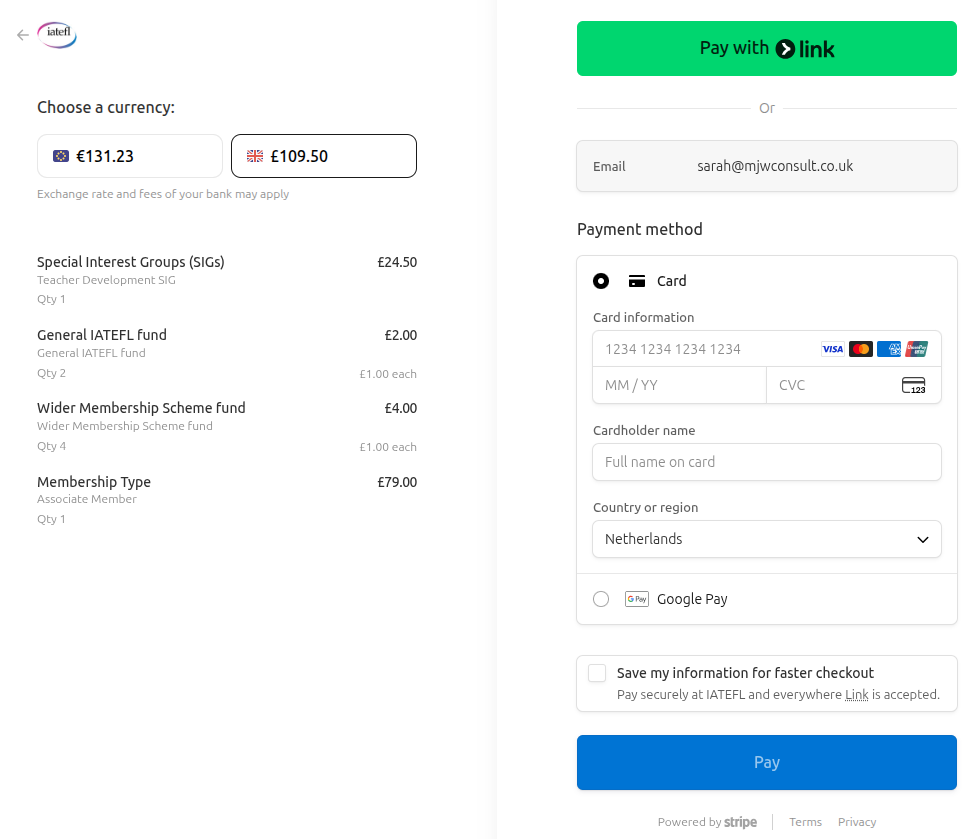
Stripe Checkout using Formbuilder Payments:
Or a Contribution Page:
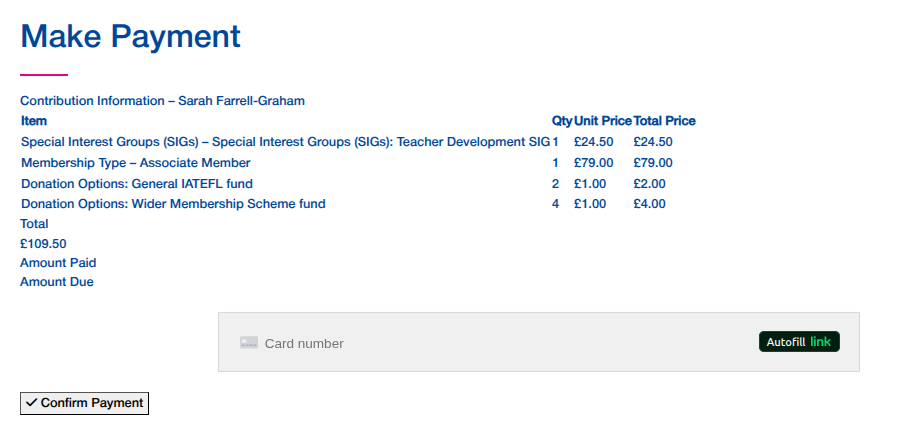
Prompts to pay if it’s pending..

The solution uses FormBuilder, WordPress menu pages, SearchKit listing tables, and CiviCRM rules (CiviRules) for automation and messaging. The shopping cart itself is a SearchKit grid with an “add to cart” action, and it includes features for entering discount codes, viewing items, generating invoices, and processing payments via options like”Pay by email” or Stripe checkout.
The Impact/End Result & Facilitation of Shopping Cart:
The organisation previously managed five separate membership types and 16 Special Interest Groups (SIGs) through a largely manual and fragmented system. SIGs relied on custom fields with manually entered end dates, renewals required close staff oversight, and organisational purchases had to be processed one membership, invoice, and payment at a time. Event registrations were similarly restrictive, capped at nineattendees per transaction and requiring manual data entry.
The introduction of a Shopping Cart system transformed this process. Built using FormBuilder and SearchKit, it allows representatives to select multiple individuals, assignmembership types, add SIGs and donations, apply discount codes, and complete everything through a single invoice and payment. SIGs were restructured as membership types, improving automation and reporting, and bulk purchasing logic was embedded into the system with automatic discounts applied when thresholds are met. The solution also removed limits on event registrations, enabling large organisations to register entire teams in one transaction.
Overall, the new system replaced repetitive manual processes with an integrated, automated, and scalable approach to memberships and events.

